
The team at Dragon Door set out to solve a frustrating limitation in traditional isometric training, the inability to measure how much force you’re actually applying. Without measurement, it’s nearly impossible to know whether you’re improving or simply repeating the same effort over and over.
Their solution combines classic isometrics with modern feedback technology, wrapped into a training system built around Paul Wade’s progressive isometric methods.
Before we look deeper, here’s the essence: the IsoChain is an isometric tool that finally gives you a number for your effort, something the isometric world has been missing for decades.
Many people turn to isometric training for different reasons, some want measurable strength gains, others need a joint-friendly way to train, some have limited room at home, and others simply enjoy data-driven, quantified workouts. The IsoChain addresses all of these needs by giving users real-time force numbers and structured, repeatable intensity.
What’s The Concept Behind The IsoChain Work Out?
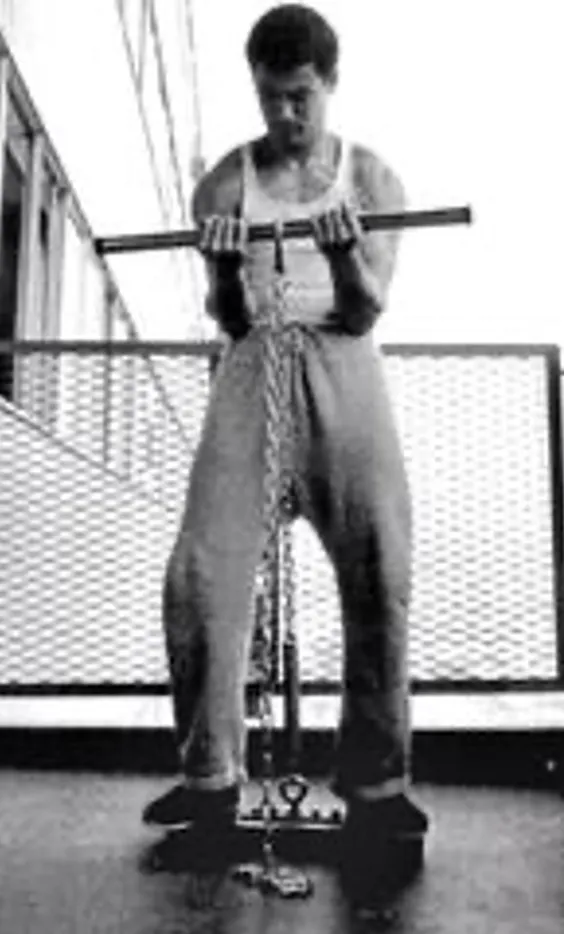
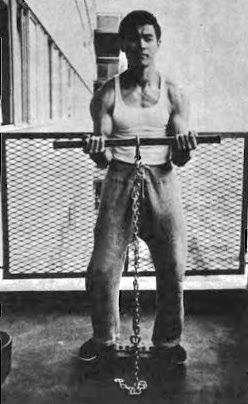
Isometric training has a long history of producing impressive strength gains, even the mighty Bruce Lee used it as part of his routine to build tendon strength, explosive power, and remarkable muscular control.
But it comes with a built-in challenge: You can’t see or feel measurable progress.
Push against a wall today, push against it next week, did you improve? Hard to tell. No reps, no bar speed, no weight changes.
That lack of feedback leads to:
- Uncertain progression
- Stalled motivation
- Difficulty planning structured workouts
Dragon Door’s concept is simple but powerful: If you can measure force output, you can train it.
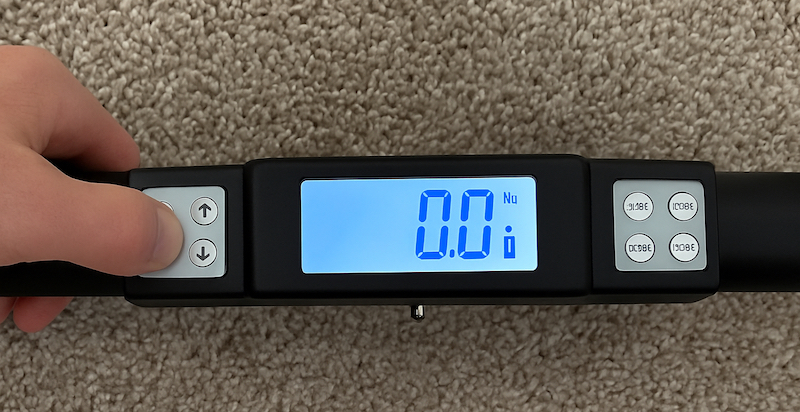
The IsoChain gives you that missing data point. You perform your isometric reps, and the onboard digital gauge shows exactly how much force you applied, down to the kilogram.
From there, training becomes straightforward: try to beat your previous numbers.
This ability to see your force output on a screen is a game-changer for anyone who struggles with stalled progress. Traditional isometrics offer no feedback, so motivation fades. With measurable targets, the IsoChain turns static holds into a form of progressive overload similar to lifting heavier weights.
| 💡 Note: The bar uses 2 AA batteries, and they’re held in quite tightly. Dragon Door designed it this way so the batteries don’t shift under the heavy forces placed on the bar during isometric pulls. |
Isometric vs Isotonic Training
Most exercises people know are isotonic, movement-based:
- pushups
- curls
- pullups
- situps
Isotonic training challenges muscle through a range of motion.
Isometric training is different. Instead of movement, you create tension against an immovable object:
- planks
- wall sits
- static holds
The muscle contracts, but the joint doesn’t move. For many people, especially those dealing with space limitations or joint concerns, this is a huge advantage.
Isometrics can produce excellent strength results while keeping impact and wear-and-tear to a minimum. For people dealing with joint pain, previous injuries, or age-related stiffness, isometric training offers a way to train intensely without the joint shear associated with dynamic lifting. This makes the method especially appealing to lifters over 40 or anyone returning to training after a setback.
How Does the Dragon Door IsoChain Work?
The setup is straightforward:
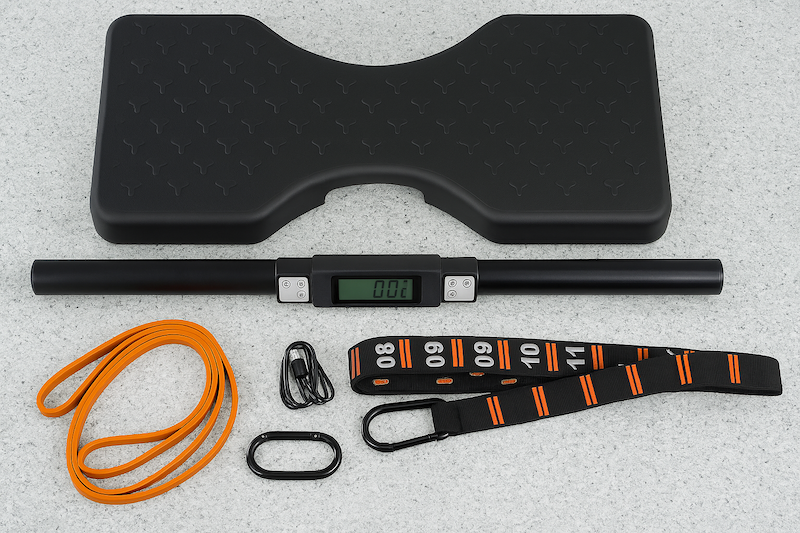
- A metal base plate sits on the ground.
- A chain connects the plate to a handle or bar.
- You stand on the base and pull or push against the bar.
- A digital gauge reads your force output in real time.
This creates isometric resistance, your muscles work at full effort, but the bar doesn’t move. The goal is to produce as much force as possible in a controlled, safe position.
Where the IsoChain stands out is the feedback loop: you see the number, you track the number, you improve the number.
One notable component is the spring, which isn’t just for aesthetics. It provides a small amount of initial “give,” helping your central nervous system engage more effectively. Without this slight elasticity, a fully rigid system would offer no tactile feedback, making it harder to gauge effort and build tension smoothly.
| 💡 Note: The updated IsoChain, now called the IsoMax, uses polyamide fiber straps that flex slightly, much like the classic spring-and-chain design. |
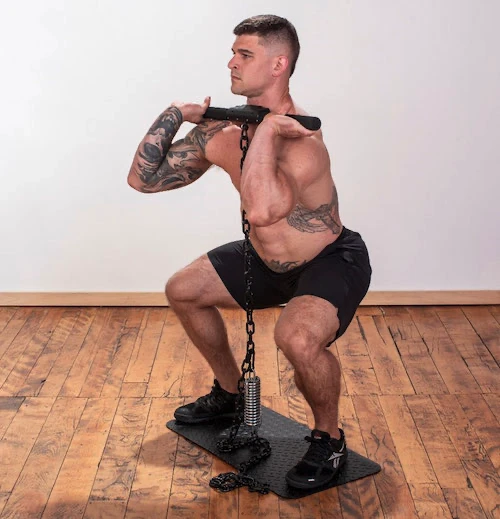
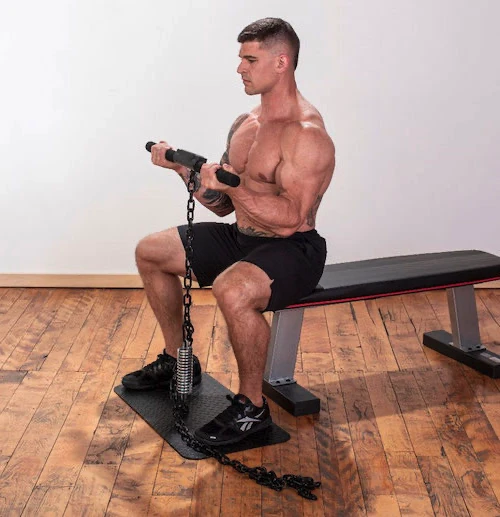
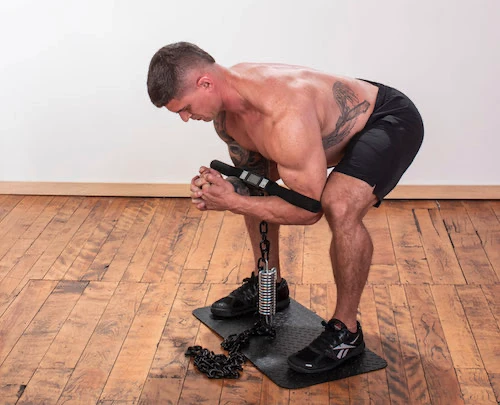
The design allows for multiple training positions, from deadlift-style pulls to overhead presses, rows, curls, squats, and more. Let’s see what this looks like:
Strength Conditioning
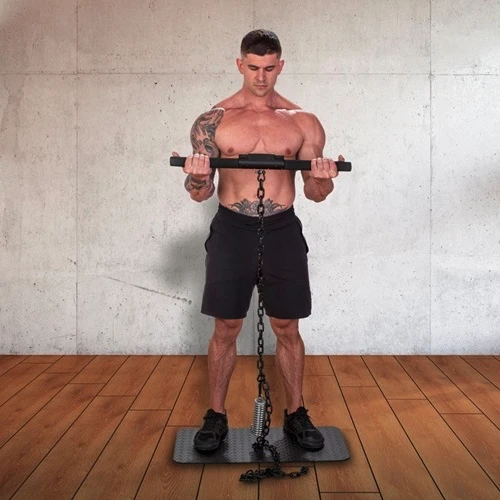
Front Squat IsoChain Training
Seated Arm Curl Training
Core & Back Conditioning
One unexpected benefit of the IsoChain is how it fits into even the smallest workout spaces. Because nothing moves, you don’t need clearance, plates, racks, or noise tolerance. For home-gym users in apartments or tight spaces, this is a major advantage.
Are There Any Programs to Follow?
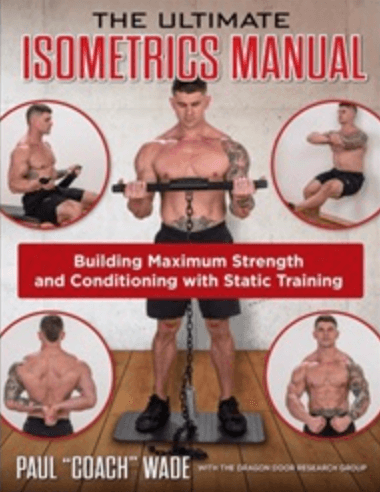
Dragon Door partnered with Paul Wade to create a structured isometric progression system.
Paul Wade’s program is currently 48% off.
If you’ve seen his previous training material, you’ll know his programs focus on:
- simple progressions
- measurable improvement
- high neural involvement
- safe joint loading
The IsoChain fits neatly into that philosophy.
For beginners, the included guides are enough to start.
For experienced trainees, the device opens up deeper variety in holds, angles, and force targets.
Why Use the IsoChain?
People gravitate toward the IsoChain for different reasons. The biggest advantages tend to be:
✔ Extremely portable
Despite being built from steel components, it’s surprisingly light and slim — easy to store or travel with.
✔ Small footprint
It occupies less than 2 square feet, making it ideal for small apartments or minimalist home gyms.
✔ No need for gym memberships or heavy equipment
You can reach high-intensity strength work without racks, plates, or machines.
✔ Digital feedback
This is the standout feature. Hearing an audible cue when you hit your target force removes guesswork from training.
✔ Joint-friendly training
Because there’s no movement, isometrics significantly reduce the risk of injury and typically allow quicker recovery.
Another reason many people choose isometric tools like the IsoChain is time efficiency. High-intensity holds stimulate the nervous system quickly, meaning full sessions can last just 10–15 minutes while still producing impressive strength results.
Benefits backed by research
Studies dating back to Müller and Hettinger (1950s) showed that isometric training can increase strength rapidly, often faster than dynamic training in certain contexts.
Here are some research papers on the benefits of isometric exercise… if you don’t believe me!
Studies show isometric exercise lowers both systolic blood pressure & diastolic blood pressure and arterial pressure. The data suggests this form of training has great potential of reducing overall blood pressure and is a good alternative way of exercising.
Mayo Clinic Proceedings – 2014
Reduction in pain and enhanced vitality was achieved with Isometric stabilisation exercise among women with chronic low back pain. The effects lasted for at least 9 months.
Human Kinetics Journal – 2012
Isometric exercise is able to offer immediate relief from nicotine craving. Or to be more precise, remove the desire to smoke.
Human Psychopharmacology – 2006
Combining isometric strength training with endurance training has shown to have beneficial effects on performance during the endurance events.
European Journal of Applied Physiology – 2012
For people who want measurable strength without increasing joint stress, this style of training checks a lot of boxes.
How Much Does the IsoChain Cost?
The IsoChain is currently priced around $499, with payment plans available through PayPal at the time of writing.
It’s not a budget item, but in context, it replaces:
- a barbell
- A chain connects the plate to a handle or bar.
- plates
- a squat rack
- multiple machines
… and it does so while fitting into a corner of any room.
If your goal is strength, not bodybuilding volume, the price ends up being more reasonable than larger home-gym setups.